
My floor looks dry but the room still smells damp
That is the situation this service exists for. A wall that is cool to the touch, a baseboard pulling away, a musty smell a week after the leak. The surface dried, the inside did not.
Structural drying and dehumidification is the trade name for finishing the job. Building materials are brought back to their normal moisture content with controlled airflow, heat and dehumidification, and the result is checked with instruments instead of by feel. To schedule readings in Maryland Heights, call (833) 521-1033.
What the equipment does
| Tool | Plain description | Why it is used |
|---|---|---|
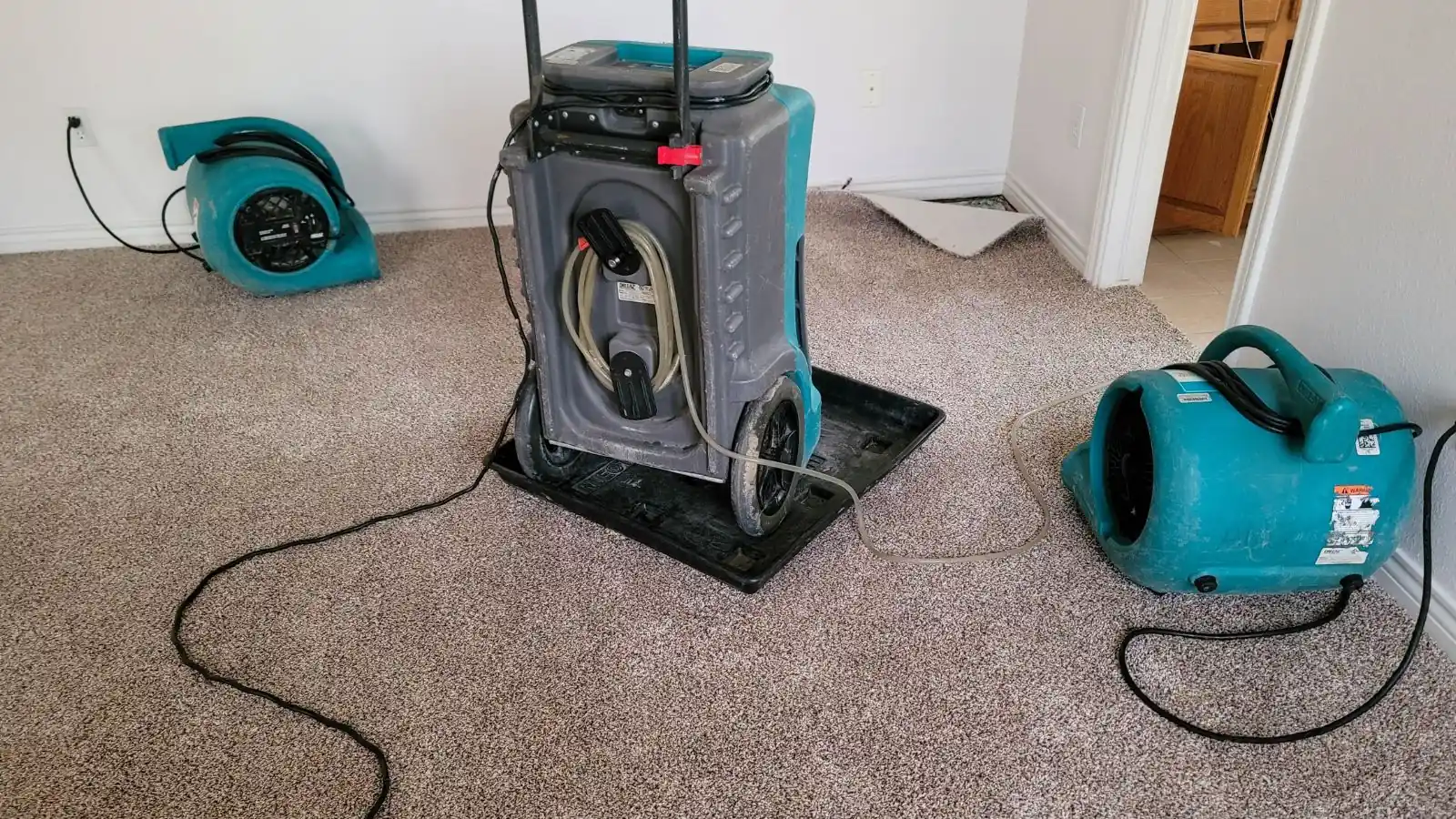
| Air mover | A low, powerful fan aimed along wet surfaces | Lifts moisture off materials into the air |
| LGR dehumidifier | Low grain refrigerant unit that pulls water from air | Removes that moisture so drying keeps going |
| Moisture meter | Pin or pinless reader for wood and drywall | Shows what is wet and when it is dry |
| Thermal imaging camera | Shows temperature differences on surfaces | Finds hidden wet areas to test |
The air mover and the dehumidifier work as a pair. Fans alone only move damp air around the room. Without something taking water out of the air, the wall stops drying.
Moisture mapping
Before equipment is placed, we map the loss. Every affected wall, floor and ceiling is tested and the wet boundary is marked. That map decides how many machines are needed and where they go.
Readings are repeated on each visit and logged. You can see the numbers fall. When they match an unaffected part of the same house, that material is dry. This log is also the record an insurer asks for.
Where water mitigation fits
Water mitigation means limiting the damage: stopping the source, extracting, removing what cannot be saved and drying the rest. Drying is the longest part of mitigation and the one most often cut short.
It follows extraction and comes before repair. If you still have standing water, start with emergency water extraction. If the structure is dry and you need walls put back, see wall and drywall repair.
How long drying takes in a Maryland Heights home
Three to five days is typical for a clean-water loss caught early. Plaster, hardwood, concrete and anything that stayed wet for a while take longer.
The house matters too. City data puts 53.1 percent of Maryland Heights housing in the 1960 to 1979 range, and the comprehensive plan gives the typical home about 1,357 square feet. Compact rooms help, since a small space is easier to hold at a low humidity. Older materials do not: plaster and dense subfloor boards give up moisture slowly.
Summer humidity in the St. Louis area adds load to the dehumidifiers when doors are opened often. We ask that the drying area stays closed and the equipment stays on.
The drying process, step by step
- Inspect and map. Meters and thermal imaging define the wet area.
- Prepare. Baseboards may be removed and small holes drilled so air reaches wall cavities.
- Place equipment. Air movers and dehumidifiers are set according to the map.
- Monitor. Daily readings, with equipment moved or removed as areas dry.
- Confirm. Final readings are compared with a dry reference in the same building.
This follows ANSI/IICRC S500, the published standard for water damage restoration. It is fair to ask any company whether its crews work to it.
Dry in place or remove: the honest trade-off
Drying drywall and flooring in place avoids demolition and rebuild. It takes equipment and time, and it only works on clean water and sound materials.
Removing wet material is faster to dry and certain, but you pay to put it back. Contaminated water removes the choice. After a sewage backup, porous materials go. For wood floors that have cupped, hardwood floor water damage repair explains what drying can and cannot reverse.
Cost factors and insurance
- Number of rooms and square feet being dried
- Materials: drywall dries faster than plaster, hardwood or concrete
- Water category, since contamination means more removal
- Number of machines and days on site
Drying after a covered loss is normally part of that claim. Ask your insurer. Expect a clear plan and a clear price ahead of the first cut or machine.
Want readings on a wall or floor you are unsure about? Tell us when it got wet.
Call (833) 521-1033Service area
Drying crews work throughout Maryland Heights and ZIP code 63043, and in Florissant, Saint Ann, Earth City, Bridgeton and Hazelwood. Local notes for homes near Northwest Plaza's former site are on the Saint Ann page.