
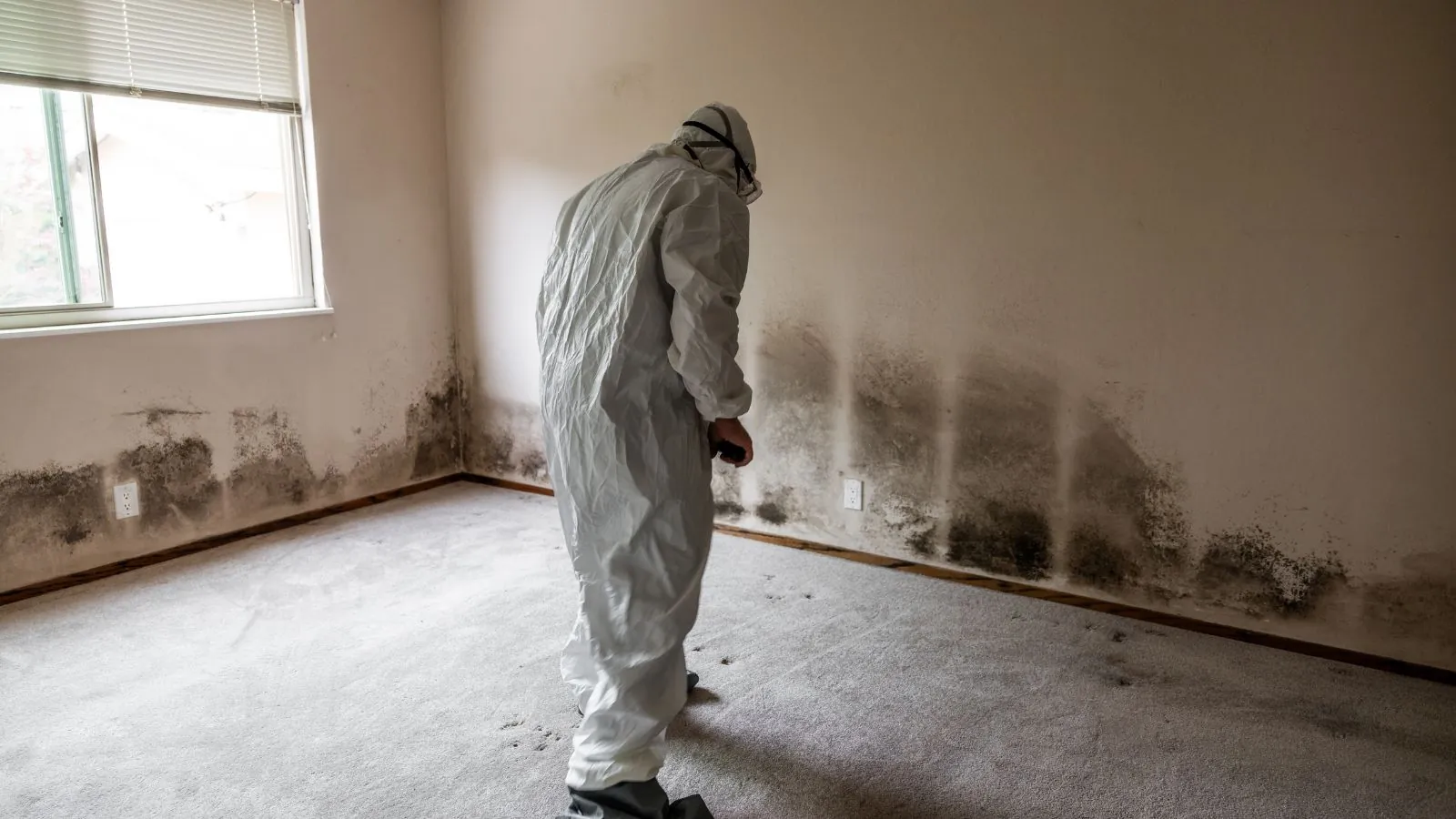
Musty smell, dark spots, a leak a while back
Most people do not search for remediation. They search for the black spots on the bathroom ceiling, the fuzzy patch behind a dresser, or the smell in a closet that will not go away. Often there was a leak weeks or months earlier.
Mold remediation is the trade name for the fix: contain the affected area, remove materials that cannot be cleaned, clean what remains, and correct the moisture that allowed the growth. To have a problem looked at in Maryland Heights, call (833) 521-1033.
Mold follows water
Mold needs moisture. In nearly every call we hear about, there is a water source behind it: an upstairs toilet leak above a basement ceiling, an AC unit dripping into a closet, a roof or siding leak, a sink that wept for a season.
That is why the leak has to be fixed first. Cleaning mold without removing the moisture is temporary. If the source is still active, start with the page that matches it, such as AC leak water damage or wall and drywall repair.
Where it turns up
- Bathroom ceilings and walls with poor ventilation
- Closets on exterior walls or beside the air handler
- Behind furniture pushed against a cool wall
- Under carpet that was lifted after a leak
- Inside walls opened during a remodel
- Finished basements that flooded and were not fully dried
People often find it by accident, gutting a wall or pulling up carpet. If that is you, stop work in that area, close the door and avoid running fans across it.
What Missouri says about mold
The Missouri Department of Health and Senior Services states that there are no Missouri or federal laws setting limits or standards for mold levels. It also says neither Missouri nor the federal government certifies any individual or firm as a mold tester.
For homeowners, that means the label on a company tells you little. Ask how the work will be done instead. The published industry standard is ANSI/IICRC S520, and it is reasonable to ask any company whether its crews work to it.
The same department advises drying wet items in 24 to 48 hours and notes that every type of mold is cleaned up the same way. Health questions belong with a physician. We do not diagnose symptoms or tell you a house is safe or unsafe to live in.
How remediation is done
- Inspect. Visual inspection, moisture meters and thermal imaging locate the growth and the moisture feeding it.
- Contain. Plastic barriers and negative air pressure keep spores from spreading to clean rooms.
- Filter. HEPA air filtration runs during the work.
- Remove. Moldy drywall, insulation, carpet and pad are bagged and removed.
- Clean. Framing and hard surfaces are HEPA vacuumed, wiped or abraded, and treated.
- Dry. LGR dehumidifiers bring materials to a normal moisture content before rebuild.
Painting over mold or spraying it and walking away is not remediation. The growth has to be physically removed.
Mold testing, inspection and clearance
Callers ask about testing more than almost anything else. The state health department's position is that when visible mold is present, sampling is usually unnecessary. You already know it is there, and the remedy is the same.
Testing has real uses. It can help when there is an odor with no visible source, or when a third party needs written results. Clearance testing after remediation is done by an independent inspector who did not perform the cleanup. That separation keeps the result honest.
An inspection does not need much notice. It is a visit with a meter, a camera and a flashlight, followed by a written scope.
Small job or professional job
| Situation | Reasonable approach |
|---|---|
| Surface mildew on tile, caulk or a painted bathroom ceiling | Household cleaning and better ventilation |
| A patch on drywall after a known, fixed leak | Remove and replace that section with basic precautions, or call |
| Growth inside walls, under flooring or across several areas | Professional containment and removal |
| Mold after sewage or flood water | Professional cleanup |
We would rather tell you a job is small than sell you a containment you do not need.
Mold in Maryland Heights homes
More than half of local housing dates from 1960 to 1979, by the city's own count. Bathrooms in houses of that age were often built without an exhaust fan vented outdoors, and finished lower levels were added later over concrete that was never sealed for it.
St. Louis summers are humid, which keeps damp materials from drying by themselves. After the record rain of July 2022, basements across the county that were dried late or not at all became mold jobs. If yours flooded then and still smells musty, have it checked along with our notes on basement water damage.
Cost factors and insurance
- Square footage of affected material
- Whether growth is on the surface or inside cavities
- Containment and filtration required
- Rebuild after removal
- Independent testing, if you choose it
Mold coverage varies a great deal. Some policies cover it when it results from a covered water loss, often up to a limit. Many exclude it otherwise. Ask your insurer. Scope first, price second, work third, in that order.
Found mold? Tell us where, how large, and what leaked.
Call (833) 521-1033Mold remediation area
We handle mold remediation in Maryland Heights and ZIP code 63043. Crews also work in Saint Ann, Florissant, Bridgeton, Hazelwood and Earth City. See the Florissant page for that city.